How do the telescopes work?
How it works, composition and use
A telescope is an astronomical instrument designed to observe distant celestial objects such as planets, stars, galaxies or nebulae. Unlike the human eye which captures a limited amount of light, the telescope allows to collect much more light and to obtain a more detailed image of the sky. Thanks to its optical system composed of mirrors or lenses, the telescope magnifies the image of celestial objects and makes visible phenomena invisible to the naked eye. Understanding how a telescope works allows one to better choose their instrument and improve their astronomical observations.
Basic principle
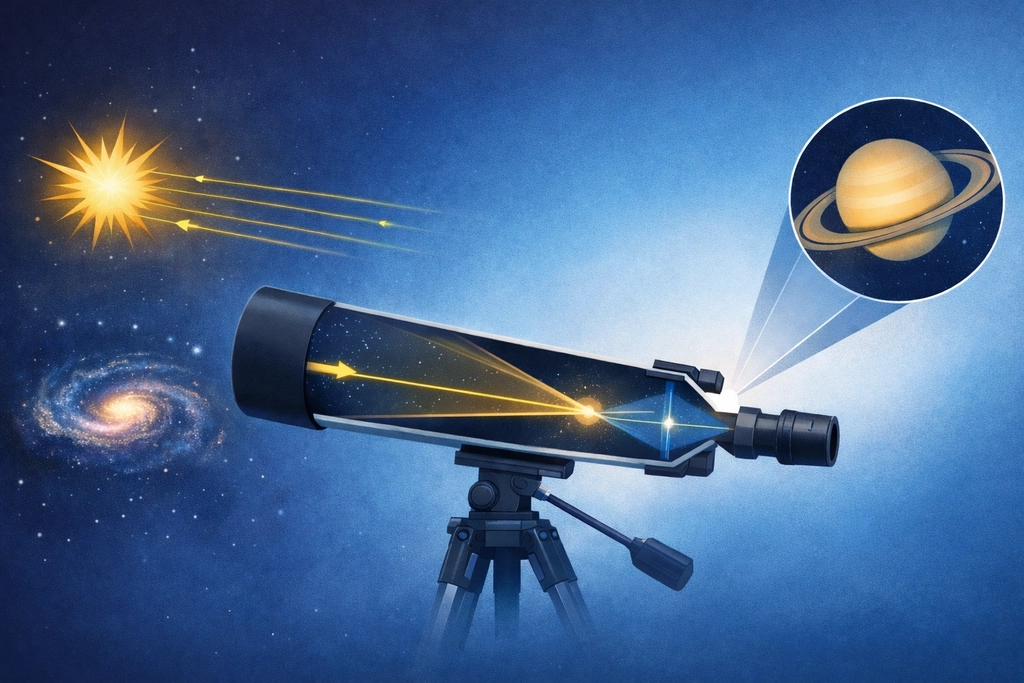
The operation of a telescope is based on a simple principle: collect light from celestial objects and concentrate it to form an observable image.
When a star, planet or galaxy emits light, it travels sometimes for millions of years before reaching Earth. The telescope captures this light through a mirror or lens called an objective.
The larger the diameter of this lens, the more light the telescope can capture and reveal faint and distant objects.
Refracting telescopes and reflector telescope
Telescopes are distinguished by the way their objective focuses light
- Refractor telescopes
- Called «astronomical glasses» in France, they are composed of lenses to capture and focus light.
- Reflector telescopes
- Called «telescopes» in France, they are composed of mirrors to reflect light and form an image. There are also «catadioptric» telescopes that combine mirrors and lenses to offer a compact and versatile telescope.
Objectives
The main element of a telescope is the lens, which can be :
- - a lens in the case of an refractor telescope
- - a concave mirror in the case of a reflector telescope
- the reflector telescope has several advantages over the refractor telescope: the light is simply reflected and not refracted which avoids achromatism, with equal performance the reflector telescope is lighter and easier to handle than the reflector telescope.
The objective collects light from the sky and focuses it to a point called focus, where the image forms.
Objective size is one of the most important criteria for determining a telescope's performance.
Eyepiece
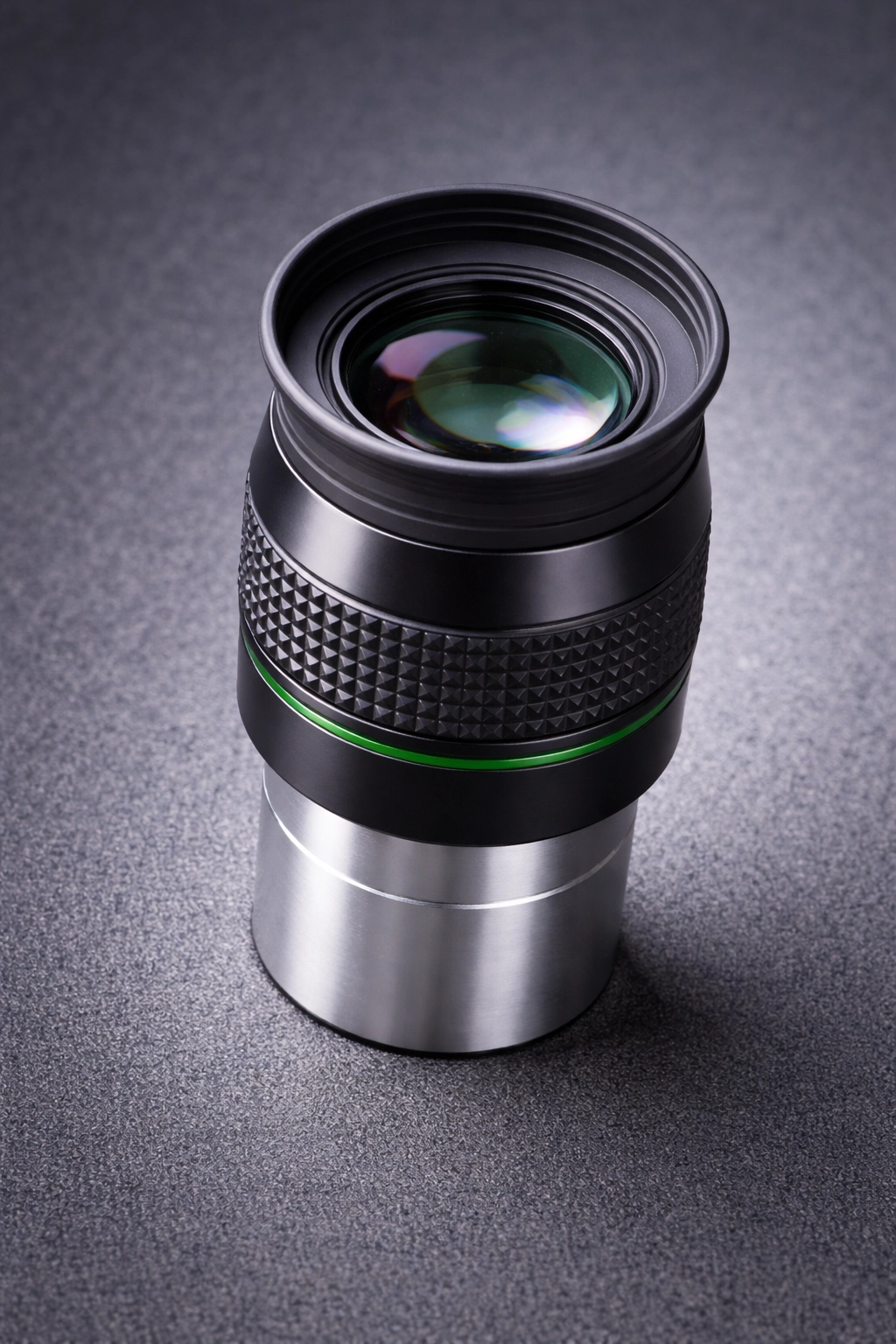
The image formed by the objective is then observed through an eyepiece.
The eyepiece acts as a magnifying glass that allows to magnify the image formed by the telescope. By changing the eyepiece, it is possible to obtain different levels of magnification.
However, contrary to popular belief, it is not the magnification that makes the quality of a telescope, but rather the amount of light it can capture.
Why the diameter is important
The diameter is the most important characteristic of a telescope because its performance depends on it.
A large diameter telescope can:
- capture more light
- show more details
- reveal distant objects
That is why telescopes intended for deep sky observation often have larger diameters.
For the commercial telescope, the diameter is generally indicated by «the Aperture» and is expressed in millimetres.
What can be observed with a telescope
With a suitable telescope, it is possible to observe many celestial objects:
- the craters and mountains of the Moon
- the cloud bands of Jupiter
- Saturn's rings
- the clusters of stars
- some galaxies and nebulae
The quality of observation will depend on the telescope used, but also on the sky conditions and light pollution.
The mount
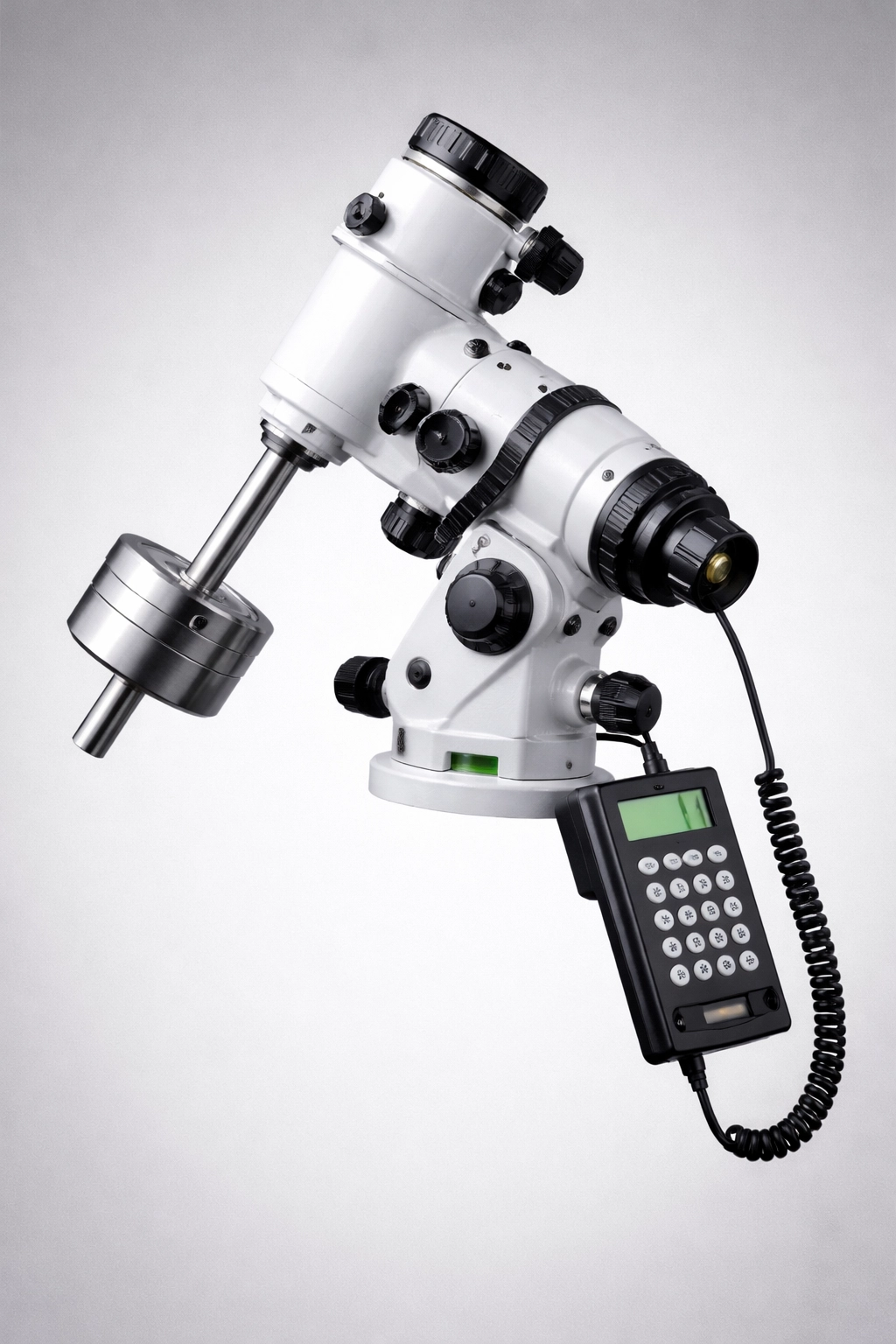
The mount is the structure that supports and allows the telescope to be oriented, it is attached to the telescope and a tripod.
There are two types of mounts :
- the azimuthal mounts
- simple to use, allows the telescope to be oriented from left to right (horizontal axis called azimuth) and from top to bottom (vertical axis called altitude), its main drawback lies in the fact that to follow a star in the sky it is necessary to manipulate both axes, which is not very suitable for astrophotography for example
- the equatorial mounts
- allows the telescope to be oriented while taking into account the Earth's rotation axis, which is ideal for following the stars in the sky, its main defect is that it is more complex to adjust and generally heavier and expensive
Choose your telescope
It is important to choose a telescope adapted to its level and budget. Several criteria must be taken into account:
- the diameter of the telescope
- the type of telescope
- the mount
- the desired use (observation or astrophotography)
You can discover the telescopes that we recommend according to the type of activity below.