Almost twin to Earth in size, but covered with toxic clouds. It is the hottest planet in the solar system.
- Diamètre12,103.6 km
- Inclinaison177.36°
- Masse4.8675x10^24 kg
- Temp. moy.464 °C
- Pér. rotation-243,023 jours
- Vit. rotation6.52 km/h
- Pér. révolution224.667 jours
- Vit. orbitale35.026 km/s
- Périhélie107,476,000 km
- Aphélie108,943,000 km
Revolution
The planets of the solar system all revolve around the Sun under the effect of gravitation.
This movement is called the revolution, the period of revolution is the time a planet takes to return to its initial position.
The planet Venus has a revolution period of 224.667 days, its orbit is inclined by 3.395° with respect to the ecliptic.
Click on the arrows in the dashboard to increase or decrease the time speed. You can thus see the distance between Mercury and the Sun in real time.
Comparison with the other planets
In order of period of increasing revolution.
| Planet | Orbit inclination | Revolution period | Average orbital speed |
|---|---|---|---|
| 1. Mercury | 7° | 87.969 days | 47.362 km/s |
| 2. Venus | 3.39471° | 224.667 days | 35.026 km/s |
| 3. Earth | 0° | 365.256 days | 29.783 km/s |
| 4. Mars | 1.85° | 686.885 days | 24.08 km/s |
| 5. Jupiter | 1.304° | 4,332.01 days | 13.059 km/s |
| 6. Saturn | 2.486° | 10,754 days | 9.641 km/s |
| 7. Uranus | 0.77323° | 30,698 days | 6.797 km/s |
| 8. Neptune | 1.77° | 60,216.8 days | 5.432 km/s |
Aphelion and perihelion
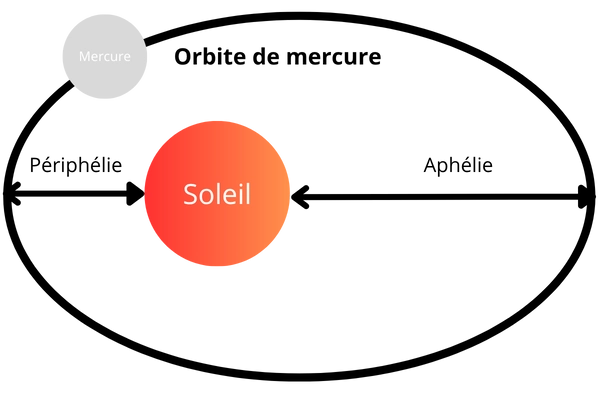
The orbits of the planets are not perfectly circular, but elliptical. This means that there is a point closer to the Sun (the perihelion) and a point further away (the aphelion).