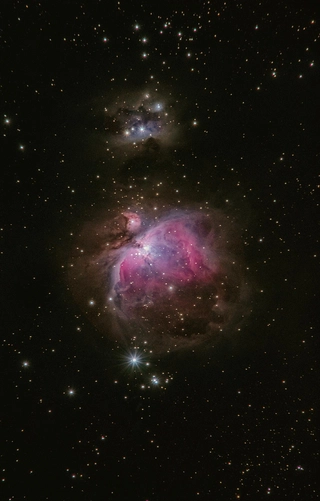
Observation of the position of the planets in real time
Visualize in real time the position of the planets in the sky.
Planets
Our interactive sky map allows you to observe the position of the planets in the solar system in the sky today.
Find in real time Mercury, Venus, Mars, Jupiter, Saturn, Uranus and Neptune according to your location.
Inclination, rotation and revolution of the planets
In addition to revolving around the Sun, the planets also rotate on themselves. They rotate for the most part in the same direction as around the Sun except for some like Venus which turns in the opposite direction of its revolution.
Access the unique planet animations:
Sky map
See the starsWe reproduce the sky with the 8 planets of the solar system, the Moon, the Sun and the Milky Way.
We accurately calculate and display their apparent positions in the sky in real time, taking into account :
- local sidereal time of the selected observation location,
- celestial coordinates of the stars, proper motion, precession, nutation and aberration of light,
- date and time.
The celestial vault is delimited to reveal which celestial objects are currently visible in the sky.
The compass tells you which direction you are looking, you can select another city to observe the sky from its position.
Use the buttons to travel through time and observe how celestial objects move in the sky as the earth rotates.
Planets data
| Planet | Rotation period | Revolution period | Diameter | Axial tilt | Current Equatorial Position | Current Horizontal Position at Marseille | Link |
|---|---|---|---|---|---|---|---|
| Mercury The planet closest to the Sun. Small and rocky, it experiences extreme temperature differences between day and night. | 58,6458 jours | 87.969 days | 4879.4 km | 0.0352° | Right ascension : 14ʰ52ᵐ17.8339496406ˢ Declination : -19°41′37.2736602375″ | Azimut : 143.62529372806227° Altitude : -62.45083725719442° | Learn more |
| Venus Almost twin to Earth in size, but covered with toxic clouds. It is the hottest planet in the solar system. | -243,023 jours | 224.667 days | 12103.6 km | 177.36° | Right ascension : 14ʰ3ᵐ26.8105226966ˢ Declination : -20°31′10.9147999025″ | Azimut : 168.6668790724339° Altitude : -66.8822539436168° | Learn more |
| Mars The red planet, famous for its iron-rich soil. It is home to the largest mountains and canyons in the solar system. | 24,622962 h | 686.885 days | 6792.4 km | 25.19° | Right ascension : 8ʰ49ᵐ43.6364605203ˢ Declination : 19°3′18.9488482482″ | Azimut : -114.81541117550279° Altitude : 1.7687252746207769° | Learn more |
| Jupiter The largest planet in the solar system. A gaseous giant with a tormented atmosphere, it has a famous storm: the Great Red Spot. | 9h 55min 27,3s | 4332.01 days | 142984 km | 3.12° | Right ascension : 9ʰ38ᵐ6.9502047088ˢ Declination : 14°47′30.7872830874″ | Azimut : -120.5045665565144° Altitude : -9.179496279891678° | Learn more |
| Saturn Known for her beautiful rings made of ice and rock. She is a gas giant like Jupiter. | 10h 33min | 10754 days | 120536 km | 26.73° | Right ascension : 0ʰ42ᵐ46.9787693064ˢ Declination : 1°39′14.2706649749″ | Azimut : 22.5866567029841° Altitude : 46.14060964794465° | Learn more |
| Uranus Icy giant with a blue-green hue due to methane in its atmosphere. It is tilted to the side, which makes it unique. | -17,23992 h | 30698 days | 51118 km | 97.8° | Right ascension : 4ʰ13ᵐ15.20144497ˢ Declination : 21°0′59.1729269555″ | Azimut : -66.17856237990986° Altitude : 51.93076782614312° | Learn more |
| Neptune The planet furthest from the Sun. Very windy and cold, it has a beautiful blue color and intense storms. | 16h 6,6min | 60216.8 days | 49528 km | 28.32° | Right ascension : 0ʰ11ᵐ21.386737863ˢ Declination : -0°18′59.2825835921″ | Azimut : 31.961178369914467° Altitude : 41.657046377766974° | Learn more |
Position of the planets in the sky today: which planets to observe tonight?
Each evening, several planets can be visible to the naked eye or with a simple pair of astronomical binoculars.
Find out which planets are visible today, how to spot them in the sky and what are the best conditions for observing them.
The movement of the planets in the sky
Unlike the stars, the planets move continuously in the sky. They orbit the Sun at different speeds and thus appear in varying positions over days and months.
All visible planets remain close to a band of the sky called the ecliptic, which corresponds to the apparent path of the Sun among the constellations of the zodiac.
Visibility
The visibility of planets depends on several factors :
- time of day
- season
- the position of the observer
- weather conditions
Unlike the stars, the planets do not flicker, which allows us to differentiate them in the sky.
Venus
Venus is usually the brightest planet in the sky. It is visible either shortly after sunset or before sunrise.
Mars
Recognizable by its orange-red color, Mars easily attracts attention when it is well placed in the sky.
Jupiter
Jupiter is among the brightest objects in the night sky. With a pair of binoculars, it is even possible to see its four main satellites.
Saturn
Saturn appears as a pale yellow luminous point. However, its famous rings require a telescope to be distinguished.
Mercury
Mercury is the most difficult to observe; it always remains close to the Sun and is only visible during certain periods of the year.
Deep sky
The deep sky is a set of celestial objects located outside the solar system.
It includes galaxies, nebulae, star clusters and quasars.
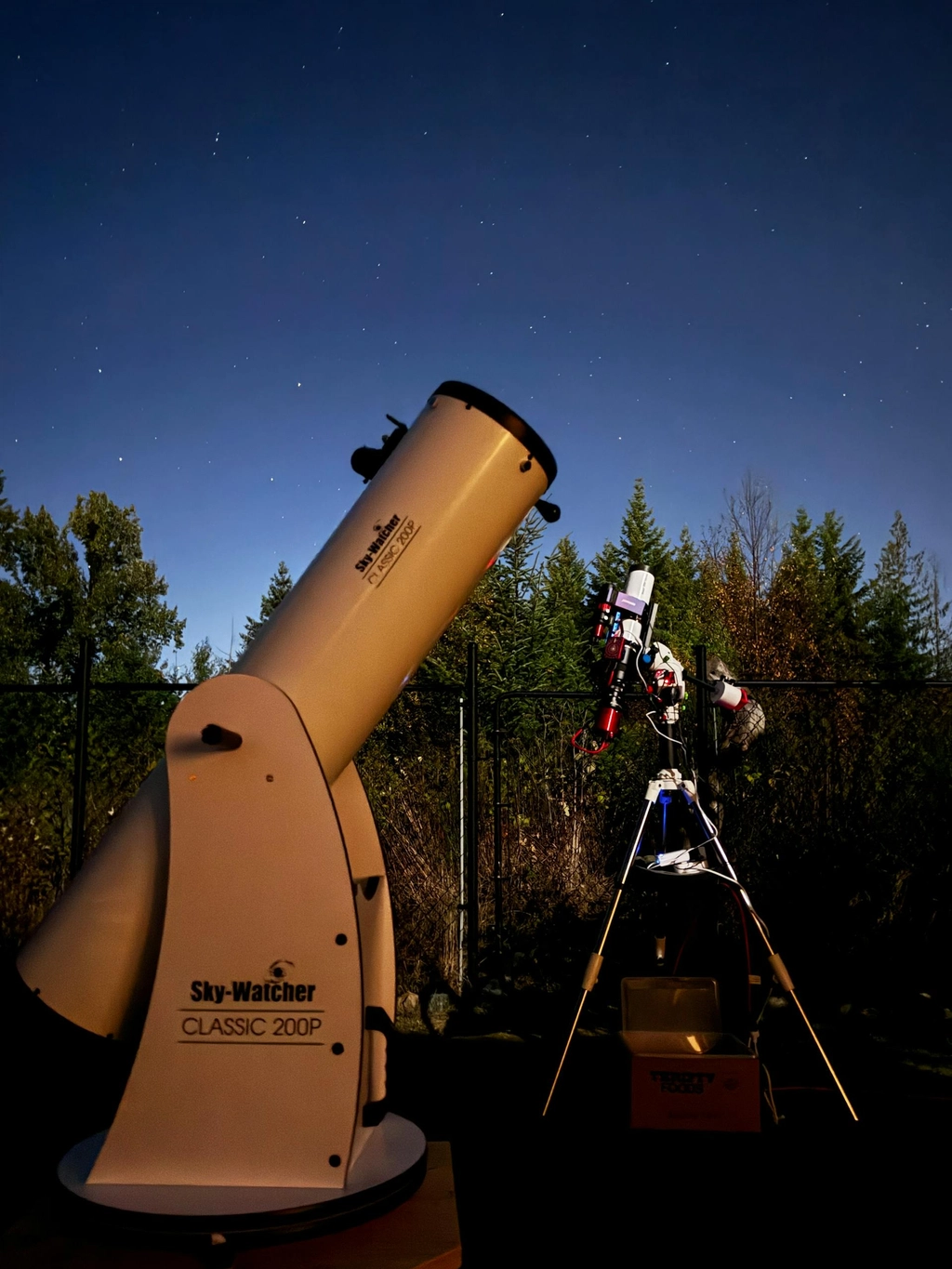
Observation equipment
Observing the night sky is a fascinating experience that allows discovering planets, stars, galaxies and nebulae visible from Earth.
To take full advantage of these observations, it is important to have the right astronomy equipment.
section5.p.line3