Revolution of the planets of the solar system
Revolution
The planets of the solar system all revolve around the Sun under the effect of gravitation.
This movement is called the revolution, the period of revolution is the time a planet takes to return to its initial position.
Each planet follows an elliptical orbit and has a different period of revolution depending on its distance from the Sun. The further away a planet is, the longer its year is.
With our interactive visualization, you can observe the trajectories of the eight planets in the Solar System and compare their orbital velocities.
Orbital characterictics
The planets all revolve in the same direction around the Sun, in a plane called the ecliptic plane.
Planets close to the Sun are subject to a greater gravitational attraction. They therefore move faster in their orbits than distant planets.
Table of revolutions in order of period of increasing revolution:
| Planet | Revolution period | Average orbital speed | Orbit inclination | Eccentricity |
|---|---|---|---|---|
| 1. Mercury | 87.969 days | 47.362 km/s | 7° | 0.2056° |
| 2. Venus | 224.667 days | 35.026 km/s | 3.39471° | 0.00678° |
| 3. Earth | 365.256 days | 29.783 km/s | 0° | 0.01671022° |
| 4. Mars | 686.885 days | 24.08 km/s | 1.85° | 0.09339° |
| 5. Jupiter | 4,332.01 days | 13.059 km/s | 1.304° | 0.04839° |
| 6. Saturn | 10,754 days | 9.641 km/s | 2.486° | 0.0539° |
| 7. Uranus | 30,698 days | 6.797 km/s | 0.77323° | 0.04726° |
| 8. Neptune | 60,216.8 days | 5.432 km/s | 1.77° | 0.00859° |
Aphelion and perihelion
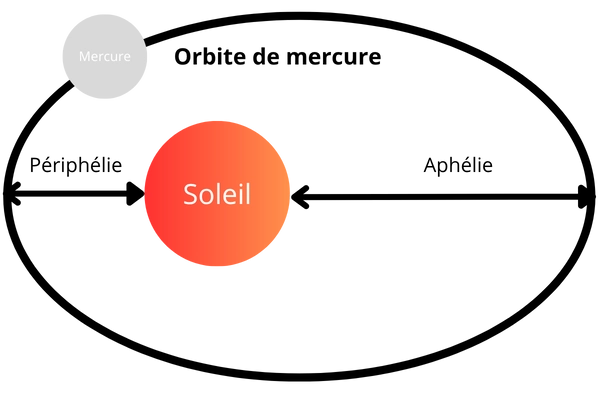
The orbits of the planets are not perfectly circular, but elliptical. This means that there is a point closer to the Sun (the perihelion) and a point further away (the aphelion).
A planet does not always move at the same speed in its orbit. When it is closest to the Sun (the perihelion), it accelerates under the effect of gravitation. Conversely, when it reaches its farthest point (the aphelion), its speed decreases slightly.
Seasons
The seasons are due to the inclinations of the planets' axes.
That of the Earth is about 23.5°, during its revolution around the Sun this inclination always remains oriented in the same direction.
This implies that for part of the year, the northern hemisphere is more oriented towards the Sun and therefore receives more light and heat, it is summer.
Six mois plus tard, c'est l'hémisphère Sud qui est orienté vers le Soleil, il y fait alors été, tandis que l'hémisphère Nord connaît l'hiver.
Six months later, it is the southern hemisphere that is oriented towards the Sun, it is then summer there, while the northern hemisphere experiences winter.