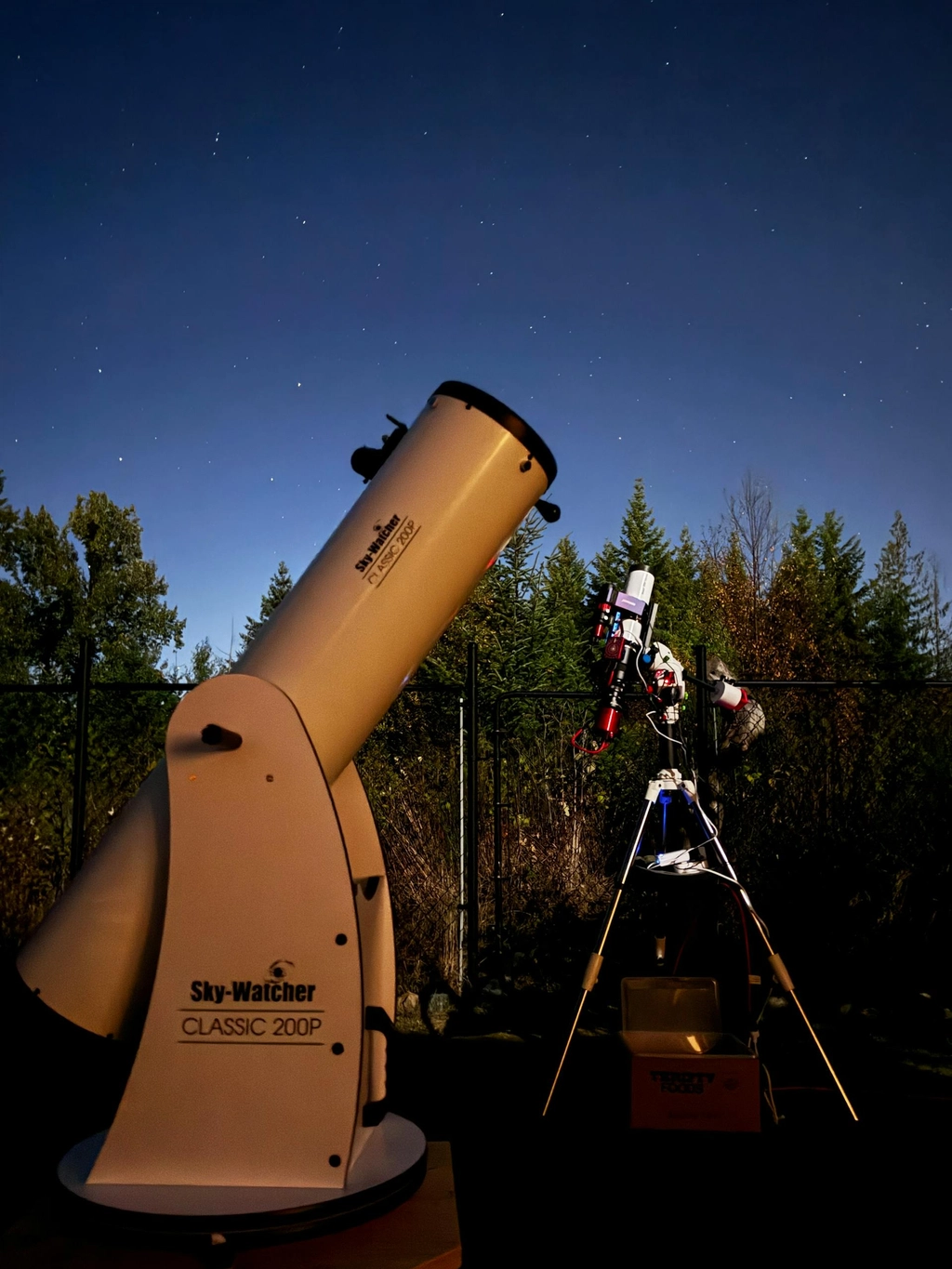
Real time observation of the starry sky
Visualize in real time the position of the stars in the sky.
Star chart
A star chart is a representation of the sky as it appears from a specific place and at a given moment.
Unlike a printed map, this interactive star chart updates in real time depending on your position and the date and time chosen.
It makes it easy to identify stars, planets and constellations.
Celestial objects
The observation of the sky allows to see different types of celestial objects such as planets, stars, constellations, galaxies or nebulae.
Some celestial objects such as the Moon, Venus and certain stars are visible to the naked eye. By contrast, deep sky observation requires the use of astronomical instruments such as telescopes.
In good conditions, it is possible to see at night with the naked eye about 3,000 stars as well as some planets.
Unlike the stars, the planets do not twinkle, which allows us to differentiate them.
The Sun: a giant star
The Sun is a star located at the center of the solar system, it exerts a force of gravity that keeps the planets in their orbits. The Sun is also our main source of light and heat, without which life on Earth would not be possible.
Inclination, rotation and revolution of the planets
In addition to revolving around the Sun, the planets also rotate on themselves. They rotate for the most part in the same direction as around the Sun except for some like Venus which turns in the opposite direction of its revolution.
Access the unique planet animations:
The planet closest to the Sun. Small and rocky, it experiences extreme temperature differences between day and night.
Diameter : 4879.4 km | Inclination of the planet : 0.0352° | Inclination of the orbit : 7° | Rotation period : 58,6458 jours | Revolution period : 87.969 daysAlmost twin to Earth in size, but covered with toxic clouds. It is the hottest planet in the solar system.
Diameter : 12103.6 km | Inclination of the planet : 177.36° | Inclination of the orbit : 3.39471° | Rotation period : -243,023 jours | Revolution period : 224.667 daysThe only planet known to be home to life. Largely covered with water and protected by a favorable atmosphere.
Diameter : 12756.274 km | Inclination of the planet : 23.4366907752° | Inclination of the orbit : 0° | Rotation period : 23h 56min 4s | Revolution period : 365.256363 daysThe red planet, famous for its iron-rich soil. It is home to the largest mountains and canyons in the solar system.
Diameter : 6792.4 km | Inclination of the planet : 25.19° | Inclination of the orbit : 1.85° | Rotation period : 24,622962 h | Revolution period : 686.885 daysThe largest planet in the solar system. A gaseous giant with a tormented atmosphere, it has a famous storm: the Great Red Spot.
Diameter : 142984 km | Inclination of the planet : 3.12° | Inclination of the orbit : 1.304° | Rotation period : 9h 55min 27,3s | Revolution period : 4332.01 daysKnown for her beautiful rings made of ice and rock. She is a gas giant like Jupiter.
Diameter : 120536 km | Inclination of the planet : 26.73° | Inclination of the orbit : 2.486° | Rotation period : 10h 33min | Revolution period : 10754 daysIcy giant with a blue-green hue due to methane in its atmosphere. It is tilted to the side, which makes it unique.
Diameter : 51118 km | Inclination of the planet : 97.8° | Inclination of the orbit : 0.77323° | Rotation period : -17,23992 h | Revolution period : 30698 daysThe planet furthest from the Sun. Very windy and cold, it has a beautiful blue color and intense storms.
Diameter : 49528 km | Inclination of the planet : 28.32° | Inclination of the orbit : 1.77° | Rotation period : 16h 6,6min | Revolution period : 60216.8 daysThe Moon, the only natural satellite of planet Earth.
The Moon is at an average distance of about 380,000 km and circles the Earth in 27.3 days.
Due to its synchronous rotation with the Earth the Moon always shows us the same face.
On its visible side there are 'lunar seas' which are large dark plains formed by ancient volcanic flows. There are also impact craters observed.
Its gravitational influence is responsible for the tides on Earth.
When the Moon passes in front of the Sun by masking it, it causes a phenomenon called solar eclipse which partially darkens the sky for a few minutes.
It takes on a reddish color during lunar eclipses: when it passes behind and finds itself in the shadow of the Earth and certain conditions are met.
The Milky Way
The Milky Way is the galaxy in which our solar system is located. It gathers between 200 and 400 billion stars and forms a wide band of light visible in the night sky.
Positions of celestial objects in the sky in real time
We reproduce the sky with the constellations and their stars, the planets of the solar system, the Moon, the Sun and the Milky Way.
We accurately calculate and display their apparent positions in the sky in real time, taking into account :
- local sidereal time of the selected observation location,
- celestial coordinates of the stars, proper motion, precession, nutation and aberration of light,
- date and time.
The celestial vault is delimited to reveal which celestial objects are currently visible in the sky.
The compass tells you which direction you are looking, you can select another city to observe the sky from its position.
Use the buttons to travel through time and observe how celestial objects move in the sky as the earth rotates.
Positions of the planets in the sky
| Planet | Rotation period | Revolution period | Current Equatorial Position | Current Horizontal Position at Marseille |
|---|---|---|---|---|
| Mercury | 58,6458 jours | 87.969 days | Right ascension : 14ʰ52ᵐ9.4470859041ˢ Declination : -19°40′52.9876305495″ | Azimut : 121.48076776332078° Altitude : -54.43475018045157° |
| Venus | -243,023 jours | 224.667 days | Right ascension : 14ʰ3ᵐ31.0248139566ˢ Declination : -20°31′39.6094113024″ | Azimut : 138.02419893388603° Altitude : -61.9406009036281° |
| Mars | 24,622962 h | 686.885 days | Right ascension : 8ʰ49ᵐ38.0231734672ˢ Declination : 19°3′38.2497561387″ | Azimut : -125.31765867469854° Altitude : -7.583632048489387° |
| Jupiter | 9h 55min 27,3s | 4332.01 days | Right ascension : 9ʰ38ᵐ5.4245854547ˢ Declination : 14°47′37.8983480062″ | Azimut : -132.29024957407483° Altitude : -17.893310932186285° |
| Saturn | 10h 33min | 10754 days | Right ascension : 0ʰ42ᵐ47.6764099338ˢ Declination : 1°39′18.5947227256″ | Azimut : 0.8293378987016542° Altitude : 48.355311162340676° |
| Uranus | -17,23992 h | 30698 days | Right ascension : 4ʰ13ᵐ15.4827279951ˢ Declination : 21°0′59.8783225983″ | Azimut : -79.79530858120205° Altitude : 41.57653589600896° |
| Neptune | 16h 6,6min | 60216.8 days | Right ascension : 0ʰ11ᵐ21.6216608586ˢ Declination : -0°18′57.7839448618″ | Azimut : 12.096424102563704° Altitude : 45.74076246735987° |
Positions of the moons in the sky
| Moon | Rotation period | Revolution period | Current Equatorial Position | Current Horizontal Position at Marseille |
|---|---|---|---|---|
| Moon | 27.32 days | 27.321582 days | Right ascension : 16ʰ34ᵐ42.2675324581ˢ Declination : -27°0′52.1002170566″ | Azimut : 89.87390803462344° Altitude : -41.34420673484548° |
Positions of constellations and stars in the sky
Orion constellation
Ursa Major constellation
Ursa Minor constellation
Aquila constellation
Andromeda constellation
Cassiopeia constellation
Aries constellation
Taurus constellation
Gemini constellation
Cancer constellation
Leo constellation
Virgo constellation
Libra constellation
Scorpius constellation
Sagittarius constellation
Capricorn constellation
Aquarius constellation
Pisces constellation
Carina constellation
Puppis constellation
Boötes constellation
Cetus constellation
Auriga constellation
Centaurus constellation
Cepheus constellation
Lyra constellation
Cygnus constellation
Corvus constellation
Crater constellation
Corona Australis constellation
Corona Borealis constellation
Delphinus constellation
Draco constellation
Eridanus constellation
Sagitta constellation
Canis Major constellation
Triangulum constellation
Piscis Austrinus constellation
Canis Minor constellation
Equuleus constellation
Perseus constellation
Lupus constellation
Pegasus constellation
Hercules constellation
Lepus constellation
Hydra constellation
Ophiuchus constellation
Serpens constellation
Deep sky
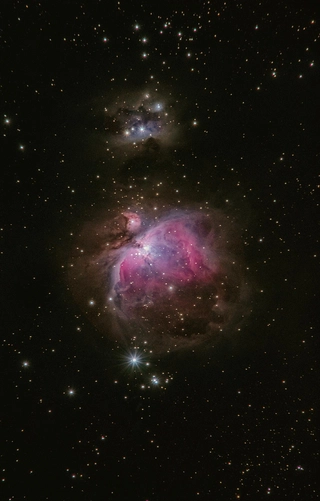
The deep sky is a set of celestial objects located outside the solar system.
It includes galaxies, nebulae, star clusters and quasars.
These objects are very far from the Earth and often low in brightness.
Observation equipment
Observing the night sky is a fascinating experience that allows discovering planets, stars, galaxies and nebulae visible from Earth.
To take full advantage of these observations, it is important to have the right astronomy equipment.